




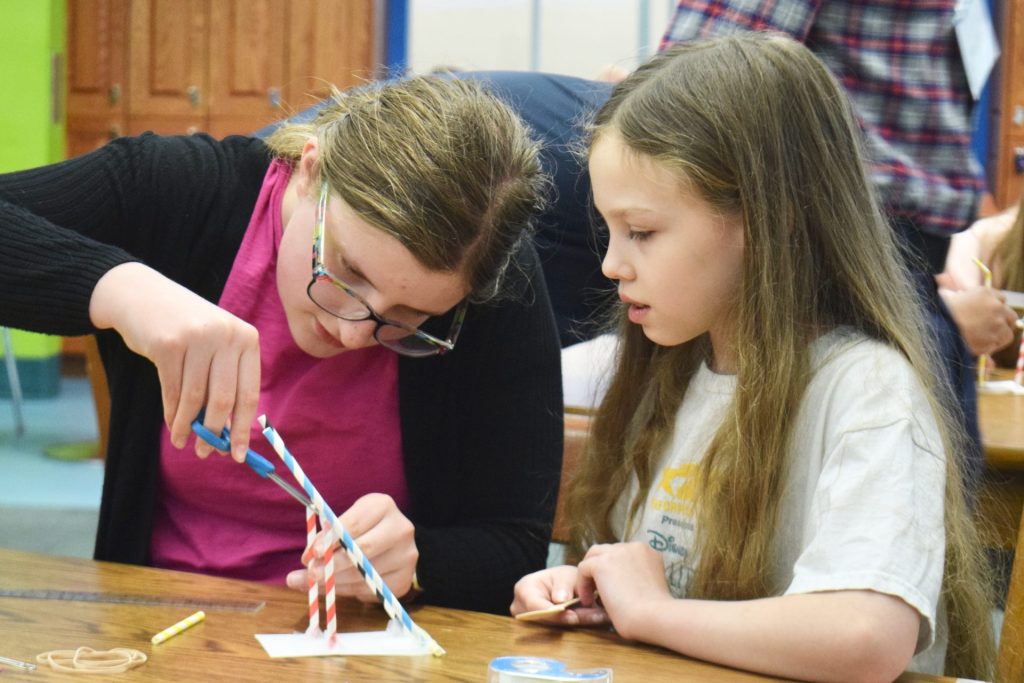
Two middle school students refine the base of their trebuchet-style catapult design.
Engineers are our greatest problem-solvers, designing and building solutions that address some of the world’s toughest challenges. Applying complex scientific, mathematical, and technical knowledge, they innovate in fields from infrastructure to healthcare, continuously improving the quality-of-life of both humans and the planet. One of our PDS parents, Kieron Hinds, happens to be an engineer for IBM, and currently specializes in testing the z/OS operating system for IBM Z mainframes. These powerful computers are trusted by companies such as Walmart, Visa, Wells Fargo, and more to handle their most business-critical tasks. At the beginning of April, as a late celebration of DiscoverE Engineers Week, Kieron joined PDS students from Grades 1 to 7 to show them what engineering is all about through an engaging presentation and hands-on activity centered on mechanical energy.
Mr. Hinds kicked off his presentation by explaining engineering and the ways in which it benefits the world. He showed students statistics on how engineers have pioneered meaningful advancements in water sanitation, medical technologies, traffic light systems, and renewable energy. He focused particularly on the story of the American startup Zipline, which has partnered with the government of Rwanda and other countries to provide a drone delivery service for hospitals. Since being implemented, the service has cut delivery times of blood, vaccines, and other life-saving supplies drastically, from 3 hours to only 10 minutes; in turn, lives have been saved that otherwise could not have been without the specially-designed drones. The takeoff process for Zipline drones, which involves them getting launched in the air by a supercapacitor-powered electric catapult launcher, offered a perfect segue for Kieron into the day’s engineering lesson: mechanical energy.
Mr. Hinds briefly described potential energy (stored energy), elastic potential energy, and kinetic energy (energy of motion) with students, using bow-and-arrows and bungee cords as tangible examples. Stress was put on the point that, the more an object stretches from its original state, the more potential energy it builds up. He also explained projectile motion, and how the distance a projectile travels depends on the angle it is launched from. A simple understanding of these concepts gave students a good foundation ahead of the day’s activity: building their own catapults!
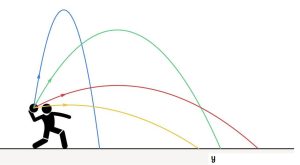
Projectile motion infographic shown by Kieron during his presentation, demonstrating how the angle at which an object is launched affects the distance it travels.
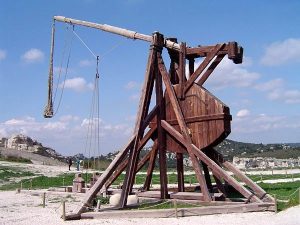
A trebuchet catapult. The bag holding the projectile is called the “sling” and the large wooden box is holding heavy materials called the “counterweight” used to launch the projectile.
With a real-world story of Zipline drones as inspiration, pairs of students were tasked with using paper straws, rubber bands, tape, and wooden spoons to strategically construct catapults in a competition to see who could most accurately launch small rubber ducks into two targets in the Chapman room. Utilizing their knowledge of mechanical energy and projectile motion, teams needed to design mechanisms that could provide both power and accuracy. As each team worked on their catapult, Kieron walked around to give them tips on general design, structural integrity, and ways to maximize potential energy for further launches. Students came up with some smart designs—many were medieval trebuchet-style, using a wooden spoon as a sling and human force as the counterweight to launch the ducks; others were crossbow-esque “ballista” designs utilizing a rubber band with high elastic potential energy to launch the ducks; some students opted not to do either of those, and made their own completely original designs! When everyone was finished building, they brought their catapults to the launch table to try and hit the two targets.
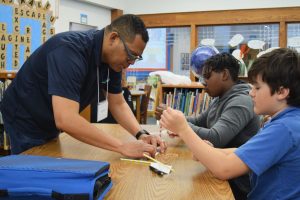
Kieron assisting two middle school students as they build a ballista-style catapult.
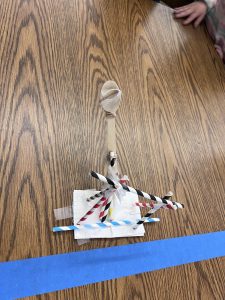
An original catapult designed by students in the 3-4 class.
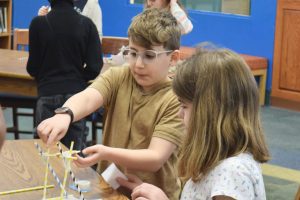
A 3rd and 4th-grade student work together to build a trebuchet-style catapult.
At their first go, many teams had a hard time getting close to the targets—their catapults were either not powerful enough or not accurate enough. They were encouraged to go back to their tables, tweak their designs, and get back to the launch table to try again. After some reworking, several launches got very close and even landed in the targets! Others weren’t as lucky—some ducks got lost in the floor, hit innocent bystanders (including the cameraman), and even landed in the cafeteria approximately 20ft away! No matter what the outcome, everyone had a lot of fun just trying.
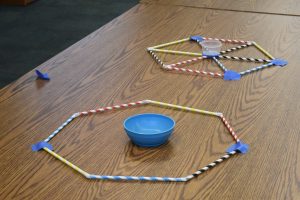
The two targets, set up on the launch table in the Chapman room.
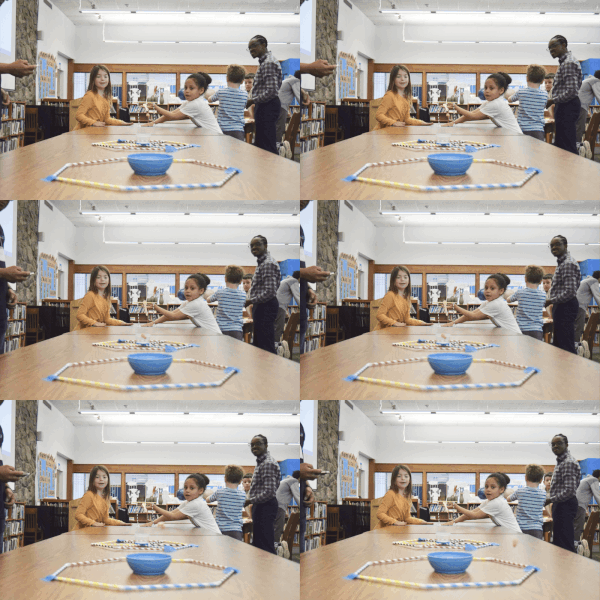
Two 1st-graders hold their breath as their duck bounces over the far target on the launch table.
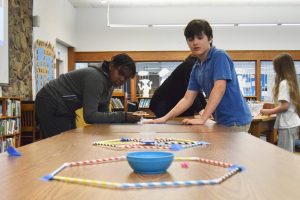
Two middle school students are unimpressed by their accurate launch. They were aiming for the bowl!
By the end of the activity, although not everyone hit the target, each and every student had an absolute blast, and was very proud of their designs, many of which have been preserved in classrooms. Through real-world connections and the hands-on catapult activity, Kieron made complex concepts easy to understand, making our students aware of the myriad impacts of engineering while also fostering a joy of the problem-solving process. Once again, he showed us at PDS that engineering, though an extremely demanding, technical, and high-stakes field, can also be a lot of fun, and even help to change the world in the process. We look forward to working with him on more projects next year!