

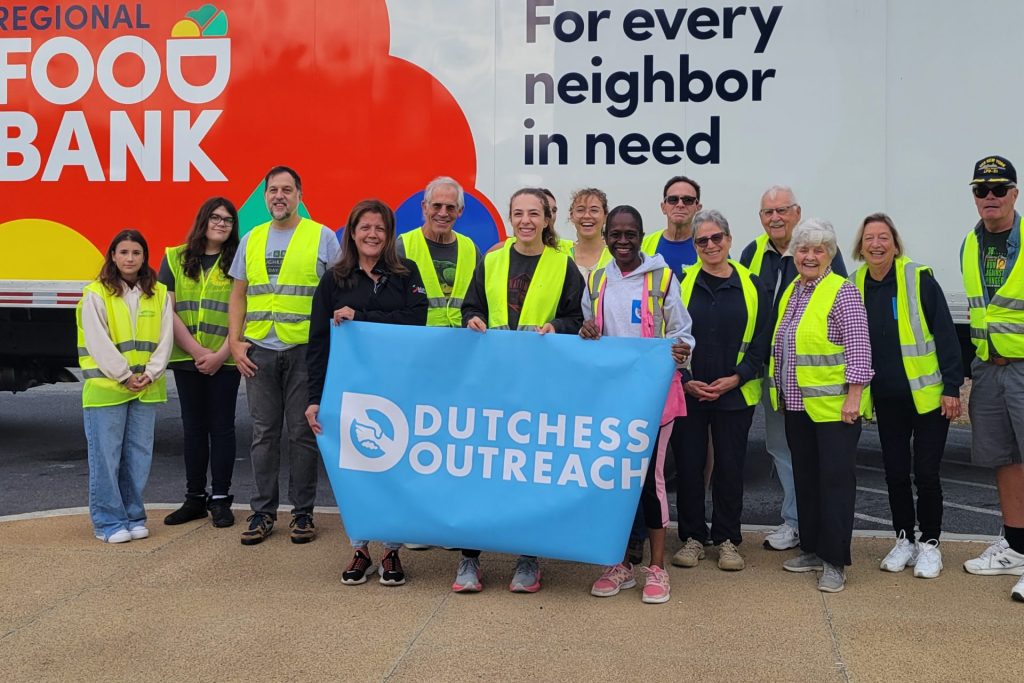
Grade 12 students, along with Head of School Spiro Gouras and other volunteers, pose proudly with a Dutchess Outreach banner after a successful farm stand event.
It goes without saying that Poughkeepsie Day School deeply values service learning. But why? What impacts does it have, both on ourselves and others? Is community service an act of justice, or just charity? In this year’s Grade 12 Central Study course, Empowering Communities Through Service, students have been exploring these questions through philosophical discussions, volunteer work on and off campus, conversations with local non-profit leaders, and the creation of their own podcast to document every step in their journey to understand the importance and meaning of the work they’re doing.
The course’s first meeting in September was spent investigating the meaning of charity through a variety of religious texts and other primary resources. Students also examined the PDS mission statement and values, finding where both charity and community service fit in with the goals of the school. Within the language, they identified a strong emphasis on a supportive community, as well as themes of compassion, equity, inclusion, justice, and connections to the local organizations in Poughkeepsie and the greater Hudson Valley.
The class then wrote their own individual mission statements, acknowledging where community service fits into their lives and personal goals. Some of these include:
“My mission is to be a good person, treat others with respect and help friends with whatever they may need. I’d like to be a positive force in my community while improving the lives of others.” – Alys Wood ’25
“My mission is to learn all I can, live life as much as possible, and help others be able to do the same thing.” – Elena Moreno-Elosua ’25
Students recorded and discussed these statements to create the first episode of their Empowering Communities Through Service Podcast. During the short recording, the group also spoke about their prior experiences with community service outside of school, which include volunteer work with Dutchess Outreach and the Trinity Pawling Theater Department.
Before getting straight to work in the community, though, they needed to receive a bit more philosophical background on its meaning and importance. So, during the class’s third meeting, students sat down for an in-depth conversation about charity with Dr. Jeffrey Fisher, an adjunct English and philosophy professor at Marist and SUNY Paltz, who is also a former PDS English teacher. This discussion was also recorded for the class podcast. Instead of immediately jumping to the topic of charity and service, Dr. Fisher first introduced the concept of responsibility, asking students to define what that means to them. Their collective answer was that a responsibility is something one owes to themself, others, and/or their community. Once Dr. Fisher started posing the question of what things the students believe they’re responsible for, it seemed no one could talk about responsibility without bringing up morality. So, naturally, he asked them what they mean by “morality.”
By and large, students talked about morality as a set of rules, or something that is taught. Dr. Fisher argued that, while this can be true, how we think of morality gets less and less rigid as we get older and our brain develops, so people’s values generally end up more unique and ambiguous. Even when raised with the same “rules,” people can turn out having substantially contrasting morals. Upon thinking about this, as well as being presented with hypothetical moral dilemmas by Dr. Fisher, the group eventually reached a mutual agreement that morals can be defined as things one feels they ought to do, or should do.
This begged the question: If it’s about personal feeling, how do we know whose morals are actually right? Dr. Fisher posited that, well, we don’t exactly. Morality is naturally subjective and ambiguous. However, he continued, we cannot just broadly accept that people have different ideas of morality and those are all valid, since some differences are simply incompatible with each other. He admits this is confusing, telling students: “…we may walk out of here with more questions than answers, but that’s what I would call ‘success.’”
As a follow-up to the idea of morals, the conversation then shifted to two of the main foci of the course: charity and justice. “Is charity something you should do?” Dr. Fisher asked the students. He went on to say that, predominantly, charity is often considered supererogatory, or a bonus—beyond what’s required morally. However, in his view, it only addresses problems rather than totally solving them. Donating money or service can help one person, or even many people, but doesn’t fix the underlying problems of, say, poverty or hunger. Justice, which Dr. Fisher posits is a moral requirement, involves systemic change that gets to the actual root of those issues. Things like running for office, social action, lobbying, and voting. Both justice and charity are certainly important, he argues, but the former is a bigger concern for the “long run.” To drive this point home, Dr. Fisher made a comparison between systemic issues and and infections: “Charity is the Advil; justice is the antibiotic.”
Now that their minds were stimulated and thinking about the meaning of their service, students collaborated to create a list of local charities and service organizations, and questions to ask those in coordinator and/or community outreach roles. Then, they got out into the community, working and speaking with the following organizations:
Dutchess Outreach
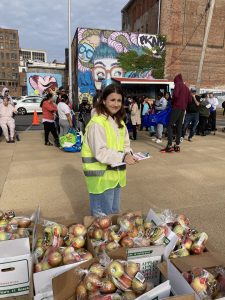
Elena ’25 awaits residents near the produce section of the Dutchess Outreach farm stand.
In late September, Grade 12 students participated in the Dutchess Outreach Farmstand, helping staff package fresh produce that was donated by local farms. Elena ’25, who speaks both English and Spanish fluently, volunteered to help with managing the line, providing assistance to and taking down information on both English and Spanish-speaking residents as they arrived. Alys ’25 and Addye ’25 helped in handing out items like books and socks, and Head of School Spiro Gouras along with courses teacher, Shira Teich, helped in handing out produce such as apples and plums.
After their service, the class interviewed Nyhisha T. Gibbs, MPA, the Director of Community Engagement at Dutchess Outreach, for their Empowering Communities Through Service podcast. Ms. Gibbs spoke with them about how Dutchess Outreach is the largest provider of nutritionally-dense food in the Hudson Valley, but also provides resources such as children’s clothing, books, housing, weatherization kits from Central Hudson, and emergency access to money for rent and other bills. Students were surprised to learn that 1 in 4 families in Dutchess County are food insecure and that, for each Dutchess Outreach farm stand, 5,000 – 13,000 pounds of food are donated and distributed to people in need. Ms. Gibbs also spoke at length about how Dutchess Outreach looks at what they do as a hand up rather than a hand out. They don’t just provide temporary resources, they help people improve their lives long-term.
Alys ’25 took particular pride in her service at Dutchess Outreach, telling Ms. Gibbs that she felt like she was really helping people, and that what Dutchess Outreach does is “really inspiring.”
Compassionate Animal Rescue Efforts (CARE)
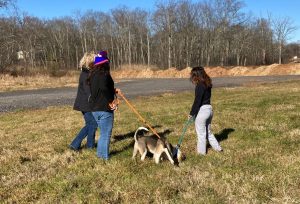
Alys ’25 and Elena ’25 walk dogs from the CARE dog sanctuary with the sanctuary manager.
In November, students volunteered at Compassionate Animal Rescue Efforts (CARE) dog and cat sanctuaries. At the dog sanctuary, they learned CARE’s protocol for volunteers to ensure the safety of the dogs and the volunteers and walked and gave play time/exercise for the animals.
After their service, students interviewed the dog sanctuary’s manager about the organization for their Empowering Communities Through Service podcast. They learned that the dog sanctuary can have between 40-70 dogs at a time, and that there are 30 active volunteers that do everything from cleaning kennels, feeding, and walking dogs, to providing them with medicine. Many dogs they take in are not vaccinated or neutered and may be sick or contain parasites. Using grants from Petco, the organization pays vets to vaccinate the dogs and perform medical procedures. Our students were saddened by the disturbing reality that old dogs are harder to find a home for, and many of them are found left on the street or in abandoned homes. They have a foster system where people temporarily take dogs into their home if they can’t handle the sanctuary environment. They have certain requirements for adoption; they want to make sure the dogs are well taken care of.
The United Way of Dutchess-Orange Region
In the winter, students organized clothes, technology, and various other items in the United Way of Dutchess-Orange Region’s Essential Needs Supply Hub. This is a central location that the United Way uses to distribute a variety of items to local organizations in need.
After their service, students interviewed the organization’s Vice President of Community Impact, Melissa Clark, as well as Deidre Sepp, who does work related to Americorps VISTA at United Way, for the class podcast. Ms. Sepp is a parent of PDS alum Kiki Sepp ’19. In their discussion, the class learned that the first United Way was started 137 years ago in Colorado by a woman, a rabbi, a priest, and two ministers around the concept of a “community chest” for local organizations. They also learned about the myriad ways that the United Way supports the local community as a hub to connect people to food pantries, financial resources, medical resources, crisis intervention, legal assistance, and more. Our students were surprised to hear that there are approximately 1200 United Ways worldwide, and United Way provides humanitarian aid in Israel. Ms. Sepp was pleased to find out that our very own Latin, Drama, and Humanities teacher, Stephen Haff, has participated in grant review at United Way!
Operation Gratitude
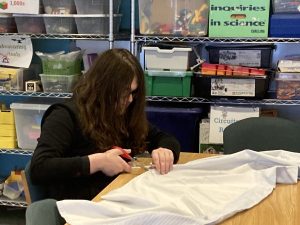
Alys ’25 cutting fabric to make into a pillow case for Operation Gratitude.
The class participated in two projects for Operation Gratitude, sewing pillow cases and creating cards for active duty service members. This includes both thank-you cards and blank cards for the troops to send back to their families. They have created a short presentation for the lower school and middle school students about this work to get them engaged in the project as well. It will be shown at the Changemakers assembly on Friday, February 14. Later, lower school students will help decorate the pillow cases and have the opportunity to make cards.
At PDS
Students have provided service to PDS in the form of assisting teachers in the lower school classrooms, as well as campus beautification, creating murals around the school.
Students have also created a ‘How can I get involved?’ bulletin board in the Chapman room. Populated with cut-out text and images, as well posters created in Canva, the board serves as a hub for all the ways people at PDS can get involved in the local community.
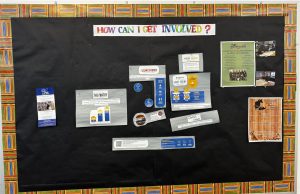
The students’ “How Can I Get Involved?” board in the Chapman Room.
Looking towards the future, students will be choosing one organization each to completely dedicate their service to during the spring semester. They will be writing journal entries, doing research into their organization and its main causes, creating PSAs to raise awareness, and looking deeper into the courses’ core questions. Each student will present their experience and findings at Graduation in June. We can’t wait to see where their journeys in take them!