





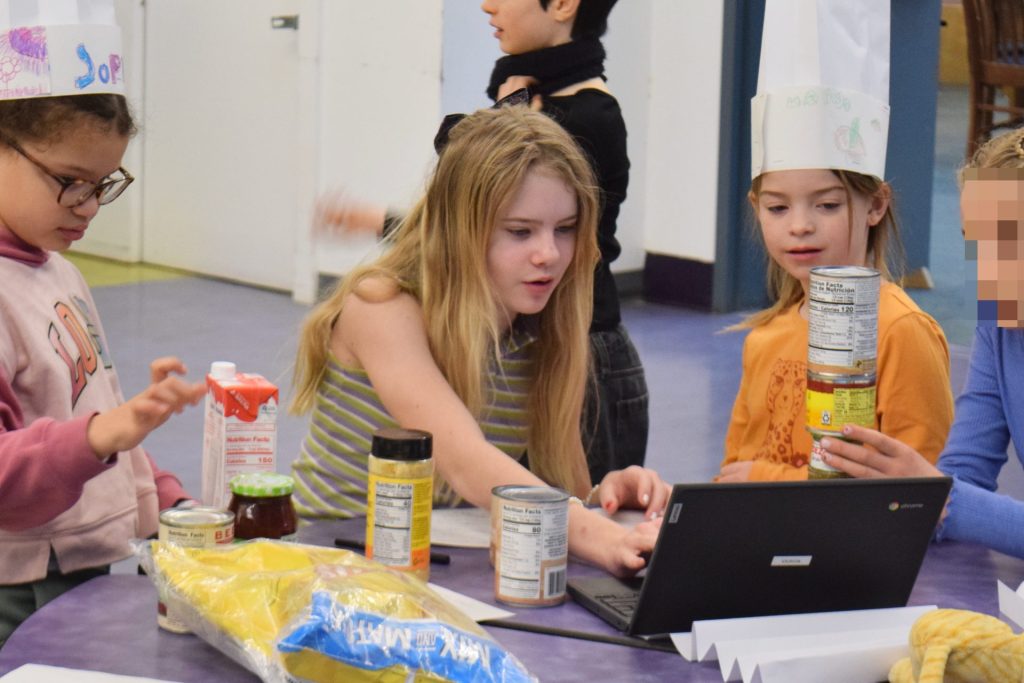
A 6th-grade Executive Chef researches recipes after gathering ingredients from the pantry and market with her team.
For over a decade, Poughkeepsie Day School’s annual Food Bowl project (formerly known as Canstruction® Jr. Hudson Valley) has been both a service to the local community and a valuable opportunity for teachers to discuss topics surrounding philanthropy, food insecurity, income inequality, and other important issues with children. Additionally—though it has changed over the years from a middle school architectural competition to a cross-divisional, culinary-themed experience—the project has always effectively integrated concepts covered in math, science, art, and social studies to show some of their tangible applications, as well as encouraged collaborative learning. In Food Bowl’s 2025 iteration, students from preK–grade 7 shined in all of these areas, proving themselves to be true “iron chefs.”
The project started with a donation drive in the beginning of February, where families, faculty, and staff were encouraged to drop off non-perishable items in a bin near the entrance to the Gilkeson lobby. These were to be donated to Hudson River Housing (HRH), a local nonprofit organization that offers emergency and transitional housing, with meals included, for individuals and families in the area. The PDS community came through with a wide variety of canned foods, personal care products, and juices—but, wanting all of HRH’s areas of need to be accounted for, students and teachers devised a plan to obtain additional items.
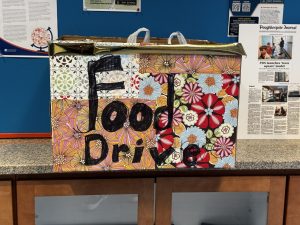
The custom-made food drive bin in the Gilkeson Lobby, which didn’t end up being quite big enough.
In order to keep the philanthropic spirit going, and not simply purchase more food, high-schoolers in the “Empowering Communities Through Service” course visited local supermarkets Stop & Shop and Adams Fairacre Farms to explain the Food Bowl project and solicit donations from each store in the form of gift cards. Their fundraising efforts were successful, and the collected cards were used by the preK/K and 1–2 classes, who took a field trip to the supermarkets to purchase the remainder of items needed. While at the stores, our school’s youngest learners were challenged to think about what exactly they were buying, and taught about how particular non-perishable products are preferred by food pantries due to their long shelf life and myriad applications. After the groceries were responsibly brought back, instead of solely donating this food along with the items from the donation drive, it was all incorporated into the new Iron Chef component of the Food Bowl project, which was introduced last year.
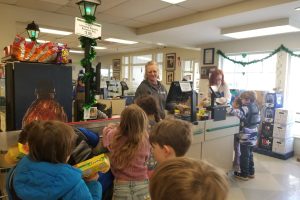
The 1–2 class checks out at Adams Fairacre Farms in Poughkeepsie.
Iron Chef, loosely based on the televised cooking competition of the same name, sees students from preK-grade 7 break up into mixed-age teams to create their own fictional restaurants, complete with a catchy name and description, proposed menu of a three-course meal, and detailed recipes for each dish—of course, all based on the items received for Food Bowl. Each team has at least one Executive Chef (5th-, 6th-, or 7th-grader), one Sous Chef de Cuisine (3rd- or 4th-grader), one Chef de Partie (1st- or 2nd-grader), and one Commis Chef (preK or kindergartener). In addition to enriching the education of PDS students, the sub-project serves as a springboard for recipe ideas to be used by kitchen staff in HRH housing facilities.
Everyone started out by naming their restaurant, deciding what kind of food it would specialize in, and determining its size (how many customers can be served at a time). Executive Chefs used Chromebooks to research potential recipes that could be created with the available ingredients. Teams took turns selecting items from the “pantry,” a collection of the food items received as donations, and if those were not sufficient for their culinary needs, they also had access to the appropriately-named “market,” which contained items bought by the 1–2 and preK/K at Adams and Stop & Shop. Back at their team tables, everyone had their own responsibilities.
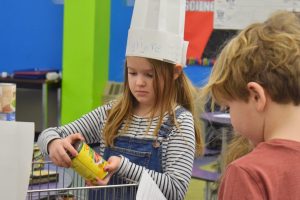
A grade 3 Sous Chef de Cuisine examines an item from the pantry to figure out if it would be useful in her team’s restaurant.
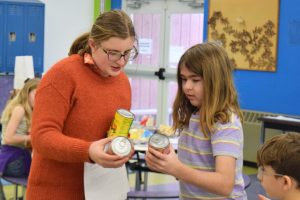
A 7th-grade Executive Chef Talks with a grade 3 Sous Chef de Cuisine about potential items to use.
Executive Chefs, mimicking the real-world responsibilities associated with their job title, mostly handled tasks of leadership. They facilitated team discussions with their younger peers to go over the nutritional balance of their meals, the variety and utility of food items from the pantry, and the affordability of the additional items bought from the market. While some of these discussions clearly called on students to use scientific and mathematical knowledge, others encouraged them to consider the circumstances and experiences of residents in HRH housing facilities. Executive Chefs were reminded by judges (teachers) that being a leader is not about being a boss and making demands; it’s about listening to and respecting everyone’s ideas. When not being leaders and resources for younger students, Executive Chefs were using their math skills to calculate calorie counts for each of their meals, and used multiplication and division skills to calculate what percentage of calories came from each course.
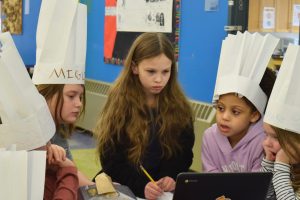
A 6th-grade Executive Chef researches recipes decided on by her team.

A grade 6 Executive Chef engaged in a group discussion with two Chefs de Partie.
In commercial kitchens, a Sous Chef De Cuisine performs managerial, administrative, and financial tasks. Likewise, our grade 3 and grade 4 Sous Chefs De Cuisine kept track of what their team bought from the market, calculating the total amount of money spent in the market and how much money was spent per guest at their restaurant. They examined nutrition labels of each ingredient they used to figure out how much of the percent Daily Value of each nutrient was in their meals, and considered food waste by figuring out how many cans/boxes of each ingredient they needed, as well as the best ways to dispose of excess food. They also oversaw the work of their younger peers, helping them with mathematics and other questions when needed.
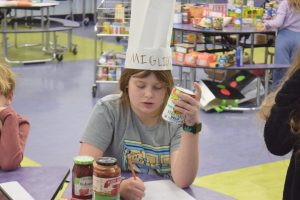
A grade 4 Sous Chef de Cuisine examines the nutrition label of the vegetable soup her team is using to calculate the percent Daily Value of each nutrient it contains.

A 3rd-grade Sous Chef de Cuisine uses infographics to help in his work.
Again, like in the real world, our Chefs de Partie and Commis Chefs worked closely together, and more directly with the food. PreK and kindergarten Commis Chefs used their counting skills to determine how many ingredients their team collected from the pantry, and then from the market. With the help of infographics and their older peers, these young chefs also organized the food items into groups by category. Using this data, grade 1 and grade 2 Chefs de Partie put their math skills to work, creating and solving addition problems to calculate the total amount of ingredients their team used. They also created addition problems to determine how many guests they would need to cook for if more or less people showed up unexpectedly, which the business would be able to use in a crunch. Finally, using crayons, colored paper, scissors, and glue sticks, the youngest team members worked together to create intriguing displays for their restaurants in the cafeteria. Students made big signs, created paper versions of each dish on the menu, and neatly laid out the items they used from the pantry and market in front for everyone else to see. Once the Sous Chefs De Cuisine and Executive Chefs were done with their work, they also joined in on the fun.

A 1st-grade Chef de Partie cuts up greens for one of his team’s menu items.
Once the work was done, awards were given to each team from a panel of faculty judges to recognize strengths within each of them, including artistic presentation, cooperative teamwork, efficiency in budgeting, mathematical thinking, and culinary creativity. Elaina Cipriano and Fredrick Cruz from Hudson River Housing also came in to speak with our students and faculty about exactly how the donations will help, as well as all the amazing work that Hudson River Housing does for our local community. We look forward to involving this incredible organization in more future philanthropic projects and continuing the expansion of our service learning at PDS.
From understanding food insecurity to practicing multiplication, division, and persuasive writing to crafting colorful storefronts to actually making a difference in the local community, Food Bowl 2025 was a fully interdisciplinary experience. Using skills from all subjects across 8 grade levels, students worked incredibly well together in mixed-age groups to create their own appealing restaurants, menus, and recipes. Everyone did their part, from the Executive Chefs who exhibited excellent leadership, to Sous Chefs de Cuisine who kept businesses affordable and sustainable, to the Chefs de Partie and Commis Chefs who made sure the food and storefronts looked flawless. In short, everyone showed themselves to be true “iron chefs.” The best part to us, though, was seeing how quick everyone was to help each other, making sure they could all succeed. We’re sure that the PDS community’s donations, as well as the recipes created by our students, will be put to very good use by kitchen staff at Hudson River Housing.