

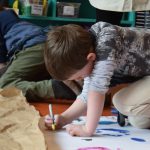
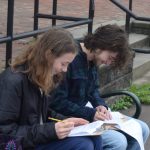


The high school is a place of amazing interactions. It is fair to say that few classrooms remain true enclosures of isolated learning. To the contrary, faculty and students seek opportunities to create and learn together – relishing the chance to spill out into hallways and common spaces and come together. Consider the collaboration between students in the intensive study Poetry course and students in the intensive study Deaf Culture course. They took a full day together to explore each other’s craft and play with each other’s language. Here is an account, written by Corina Z. (a senior and proficient ASL signer), of how ASL met poetry and of the opportunities for dialogue and debate emerged. Corina is a co-teacher of the Deaf Culture course with faculty member, Jonathan Heiles. She describes working with students in Poetry, a course co-taught by senior Elijah S. and faculty member, Josh Brown:
Last week the Deaf Culture class had the opportunity to put our new signing skills to work by interpreting poetry written by the vertical block poetry course. Interpreting poetry into American Sign Language is a complicated project, since signers need to focus on the meaning and intent of the poet and the particular poem through their chosen signs and grammar, and also they need to concentrate on facial expression, emotion, and space, all of which are factors in deciding how to interpret a poem. We spent an entire day at school working individually and in pairs to interpret different poems and finding the most expressive and accurate ways to maintain the meaning of the poems, while also presenting visually appealing and expressive poetry. This process took a lot of thought and discussion. Interpreters sometimes needed to take creative license with a concept. This included switching lines around slightly to create an order of events that was better represented through the American Sign, as well as choosing synonyms that we believed would be more visually and conceptually pleasing than the original choice. When our two classes met, we shared our work by having the original poet read his or her piece to the group; then the interpreter would do his or her interpretation twice: once to allow everyone to absorb the imagery and appearance of it, and a second time to explain its exact meaning in ASL, and how it was signed. This led to an extensive discussion of the rights of an interpreter, the intentions of poets, and the ideas and subtleties that are lost and gained when a poem is translated into any language. In the end, it was a wonderful opportunity for our Deaf Culture class to have a chance to view the poetry being written by our peers in Poetry and for those students to learn more about ASL and see the work and progression of our class.—Corina Z.