



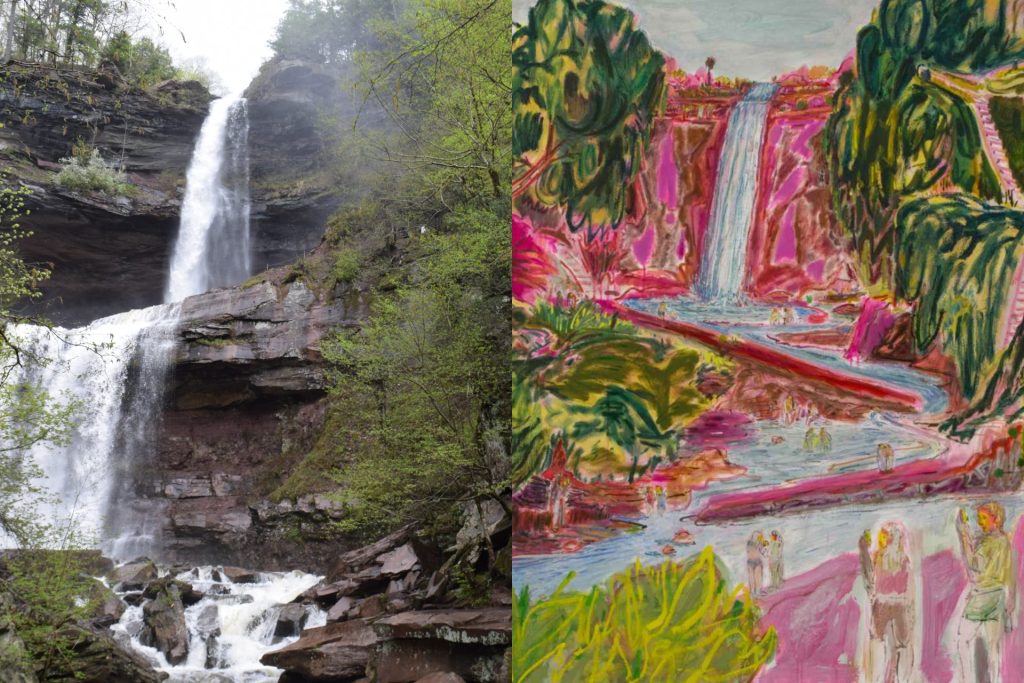
A side-by-side view of Kaaterskill Falls by Lisa Sanditz (right) and the real-world desination.
Started in 2007 by former Head of Lower School, Mary Ellen Kenny, the Take One Picture project has been a hallmark of the Poughkeepsie Day School experience for nearly 20 years. It starts with the selection of one painting from the Frances Lehman Loeb Art Center at Vassar College; then, students in each class come up with their own interpretations and reactions to the piece, which they express through unique creative projects. For the last two years, all school divisions have been involved, congregating with parents and teachers in the Loeb’s Taylor Hall to share their work at the end of the year. This year proved to be a historic one, as the chosen painting—Kaaterskill Falls by Lisa Sanditz—depicted a real place, no less one within driving distance. So, for the first time, students got to physically experience the painting they analyzed in the classroom, and it resulted in some wonderfully imaginative presentations.
After learning that the subject of this year’s Take One Picture project was just an hour’s drive away, members of the faculty quickly came up with the idea of taking a field trip to the location. Not only would this allow students to get a better understanding of the piece by experiencing the setting for themselves, but it also made way for location-specific learning that could be integrated into each class’s presentation. Aided by the largest number of faculty and parent chaperones we have witnessed in quite some time, the trip became a reality in early May.
On arrival at Kaaterskill Falls, the PDS group first hiked through the Kaaterskill Forest to the Falls Viewing Platform, where everyone stopped to eat a snack and take a look at the waterfall. While there, classes and families took photos and stood in awe of the beautiful cascade from a great vantage point. One middle school student, a passionate photographer, brought his own drone to take impressive aerial shots.
After everyone had finished their snack and taken their last pictures, the group trekked even further down to see (and feel) the falls and stream up close. On the way down, students made observations about the surrounding nature and completed location-specific work for their Take One Picture presentations. 1st and 2nd-graders were on the lookout for trees that suited the tree houses they were making in art class, which they imagined as homes for the area’s wildlife. Grades 3 and 4 made multiple stops to take in and record what they noticed about the surrounding environment to incorporate into a landstory—an informational first-person narrative written in the perspective of the land, based on the Indigenous belief that all parts of the earth, even the rocks and water, have agency and a spirit.
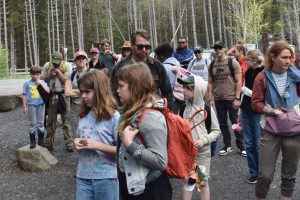
The PDS crew arrives at Kaaterskill Falls.
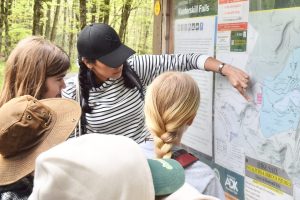
Grades 3 and 4 teacher, Samantha Nadal, shows students which trail they will be hiking to get down to the falls.
After taking on several flights of steep stone steps, the PDS crew finally made it down to the bottom of Kaaterskill Falls. Now at the exact vantage point of Lisa Sanditz’s piece, they were just about living inside the painting. Everyone sat on a large rock with a great view of the falls and ate lunch. Of course, even more photos were snapped here, and some students were even brave enough to dip their toes into the stream. Being the final destination, it was a perfect time to continue observations of nature. Although the group had reached their goal, the the way back up would prove to be much more difficult! After some sweat and a good leg workout, they made it back up in one piece, now with an enriched understanding of and appreciation for Sanditz’s painting.
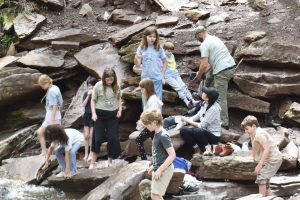
Students enjoy the rocks and a bit of the water under the falls.
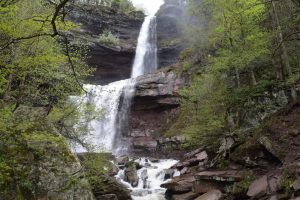
A picture of Kaaterskill Falls from below, at the exact angle imagined by Lisa Sanditz in her painting.
Only a week after the trip, PDS students, families, and teachers gathered in Taylor Hall at Vassar College’s Francis Lehman Loeb Art Center for Take One Picture presentations. The first group to take the stage (after an introduction from Spiro) were the PreK and Kindergarten. They reacted to Kaaterskill Falls by creating a cinematic storyline about water pollution that features a combination of original and borrowed fictional characters. Featuring stars such as “Cookie Rabbit,” “Nice Dog,” Sonic the Hedgehog, and Optimus Prime and Megatron from Transformers, the story starts out with a group of animals playing happily in the waterfall and all the surrounding nature. Then, disaster strikes when Sonic shows up and opens a portal to transport Kaaterskill falls to the dump. To make things worse, Megatron pollutes the water with dirt and cans, making it completely unfit for the animals. Not to worry, though, as Optimus Prime comes to the rescue by pouring a magic potion into the water to make it clean again, and all the animals can live in harmony once again. The story was brought to life through a video filmed in the Chapman Room, where each student plays a character, represented by puppets they made in art class with Melanie Girdlestone, and recites lines. The video included special effects such as an animated portal and dirty water magically turning clean from Optimus Prime’s potion. At the end, the whole class, with puppets in hand, enthusiastically sings “Water” by Bob Reid with music teacher Ken McGloin. It was an excellent environmental message from our youngest students!
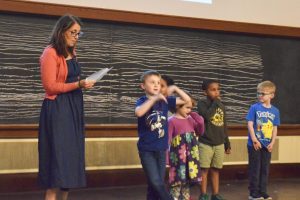
The PreK and Kindergarten introduce their video on stage.
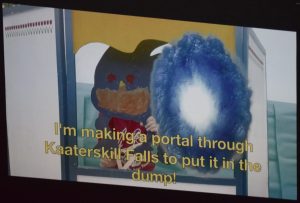
Sonic opens a portal to Kaaterskill Falls to put it in the dump!
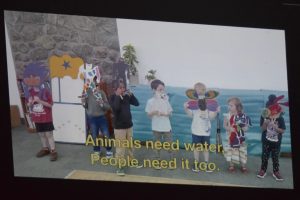
The class singing a line from “Water” by Bob Neil.
Next up were Grades 1 and 2, who created miniature tree houses that they imagined for Kaaterskill Falls’ wildlife. In art class with Melanie, they built the houses using a variety of materials, including hot glue, popsicle sticks, pipe cleaners, wooden blocks, felt, pom poms, and even Legos. First, students planned their constructions by drawing 2-dimensional blueprints on graph paper, and then built structures accordingly. As previously mentioned, on their trip to Kaaterskill Falls, each student chose a location where they imagined their treehouse to be, and then took a picture of it. Through the magic of photo editing, each student’s treehouse was digitally placed in their chosen locations and presented on stage.
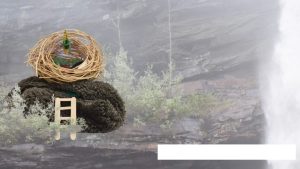
One student’s treehouse, complete with a ladder, was designed as a bird’s nest.
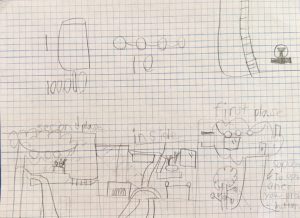
A 1st-graders ambitious, well-labeled blueprint.
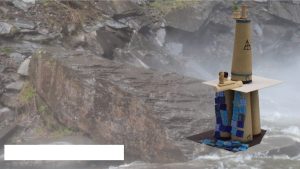
A 1st-grade student decided that, instead of a tree, they would put their structure on a rock, since it is modeled after a lighthouse.
Grades 3 and 4 shared their completed Kaaterskill Falls landstory that they worked on both in class and on-location. As part of their study of Indigenous people, the class was already working on a landstory about the entire Hudson Valley, but doing one on just Kaaterskill Falls was a great opportunity to get more in-depth. Back at the falls—orginally called P’tukw’t (where the water falls) by the Mohican and Lenape—the 3-4 made several stops while hiking to observe nature using all of their senses. The children spoke the Mohican phrases “Nuláni” (I see you) and “Nulahókan” (I hear you) with one hand on the earth and one hand on their heart to show respect to the land before they learned from it. They used the Indigenous medicine wheel as a guide, associating each of the four winds with different aspects of nature—water, stone, plants, and air—and wrote down their observations about each one. They wrote their landstory by each contributing one observation, one Mohican/Lenape word, and one promise about how they will treat the land. At the end of the trip, they even spread wildflower seeds as a way to give back to the earth. Their story was presented on stage, preceded by a land acknowledgement, showing respect to the Munsee Lenape as the original stewards of our land. It goes through the students’ observations, scientific and historical facts they learned about the falls, and the ways in which Kaaterskill Falls is connected to the Lenape and Mohican people. After the story, each student shared one promise for the land and where they would take its story. It was another beautiful project that showed the students’ deep appreciation for the environment and our country’s Indigenous people.
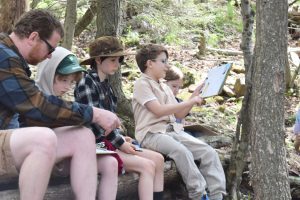
Grades 3 and 4 during one of their stops for observation during the trip.
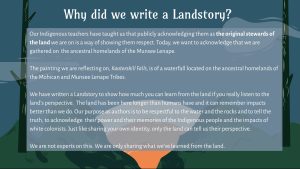
The class’s land acknowledgement and introduction to their landstory.
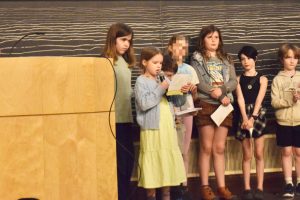
A 3rd-grade student shares her promise to Kaaterskill Falls.
Grades 5, 6, and 7 presented their own artistic responses to Kaaterskill Falls, including acrylic paintings on canvas, aerial photographs taken with a drone, and a digital collage. The acrylic paintings were directly based on Kaaterskill Falls, and students explained the differences between the original piece by Sanditz and their paintings and the reasons for those differences. Some chose to go with different color pallets, some chose to go more realistic and add more details, and some went for a style similar to Sanditz. The aerial photographs were, of course, taken on the field trip. Each of them is breathtaking, showing different views of the falls from above, and there’s even one of the PDS crew waving on the viewing platform! One student, Jeremy, made a comedic promotional flyer for “Jeremy Falls,” which is just Kaaterskill Falls with several copies of his face turned blue and superimposed on top. Clearly, they all had something unique to offer, and were the last presenters to take the stage.
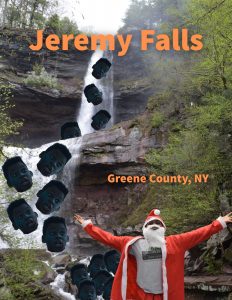
Jeremy Falls in all of its glory.
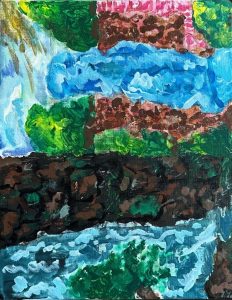
A Grade 6 student’s acrylic-on-canvas interpretation of Kaaterskill Falls.
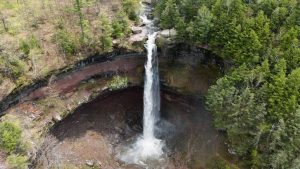
An aerial shot taken on a drone by a 6th-grade student.
And so, another successful year of Take One Picture drew to a close. It was a great privilege to be able to visit the site of a painting for the first time in this tradition’s history, especially in how it enriched the learning of our students. Their newfound connection to the painting inspired all sorts of wonderful ideas that they proudly presented on stage at the Loeb. Once again, we were thoroughly impressed, and are truly excited for next year’s Take One Picture to see what wonderful new ideas will take shape.