





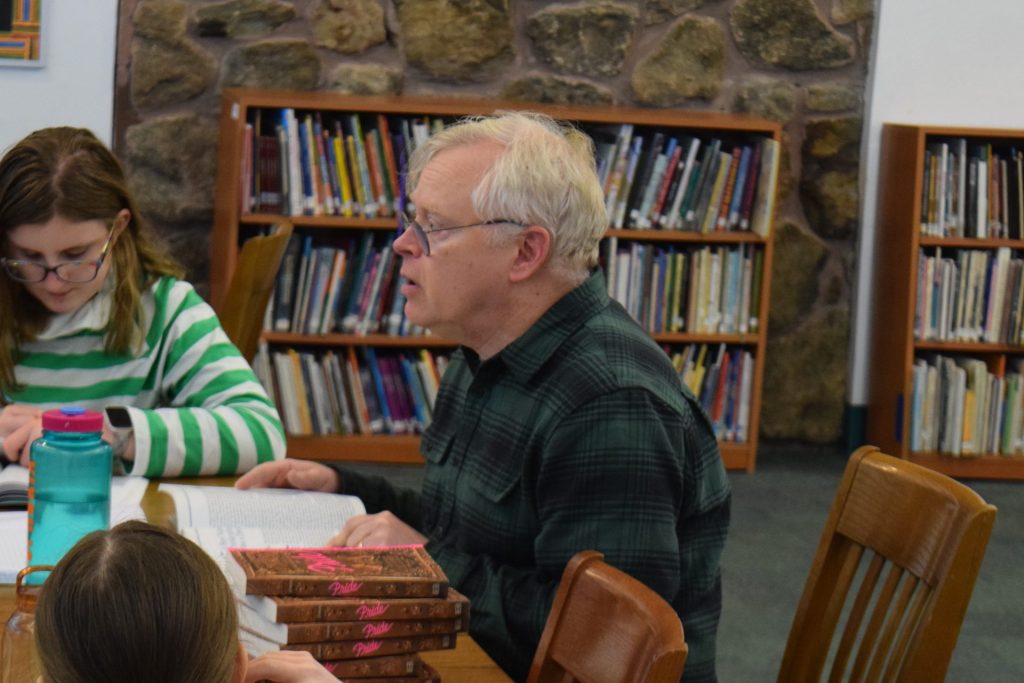
Stephen Haff discusses Fast Food Nation by Eric Schlosser with students during a group reading.
Nobody likes a liar. Stephen Haff’s middle school humanities students, as they compare the societies of Indigenous communities and European colonies with modern-day America, have been investigating perhaps some of the biggest liars in the world: large corporations. In analyzing the values of contemporary America, the class has taken a deep dive into the hidden evils of the food industry, the real-life expenses of monetary cheapness, and how companies like Disney and McDonald’s profit from deceiving children. Now, they’re writing passionate essays which expose these truths and illustrate their firm belief that lying to the young is absolutely unethical.
Students began looking into the mercenary tendencies of corporations by reading Fast Food Nation by Eric Schlosser and watching the documentary Food, Inc. by Robert Kenner. Both the book and film delve into the intentionally suppressed crimes of large-scale food production, including harmful effects on animals, workers, the environment, and the health of the American people. Each of these vices, the class’s essays reveal, has a single motivation: profit. Every step in the production process—from planting and breeding to sale—has been streamlined and mechanized in order to generate the most food as cheaply and quickly as possible, no matter what it costs in other ways. As 6th-grader Victoria contends, “These companies only care about how much money they get.”
In their papers, starting from the beginning of the food processing chain, students first discuss the painful lives of factory farm livestock destined to be sold as meat. “Most children are unaware of the lives these animals live and the hardships they face” notes Olivia, Grade 7. The class writes about the chickens, pigs, and cows purchased by multinational suppliers and how they live packed tightly together in unsanitary conditions, genetically engineered to grow much larger and/or much quicker than they’re supposed to in order to yield more meat. As a result, the animals are in a constant state of physical suffering and often become sick with bacterial and viral infections.
The students’ writing also describes the forced corn-based diets of livestock due to the cheapness of the crop, which is subsidized by the government. In cows, this diet causes heightened amounts of e coli O157:H7 in manure, which many of them walk around and stand in all day long. The e coli ends up in the cows’ meat whey they’re slaughtered, and even gets on vegetables and other crops through surface runoff when it rains. This contaminated food, which can be deadly to humans, makes its way into restaurants and supermarkets, and into our mouths. None of that matters, though, as long as the process is efficient and cheap.
Our Grades 5-7 humanities students say it’s not just multinational food suppliers saving money, though; it’s us, too. The low cost of corn being fed to animals on factory farms means the meat sourced from those farms can be priced competitively. The same applies to foods based on soy beans, wheat, and other commodity crops subsidized by the government. This is why much of the food in our supermarkets is created with engineered corn or soy-based ingredients, like high-fructose corn syrup, maltodextrin, diglycerides, and various artificial flavors. “You don’t want to eat something that sounds like an alien’s name” comments Jeremy, Grade 7. But, cheap ingredients keep the prices low, and that’s attractive to customers.
The children go on to say that these ingredients are also often paired with excessive amounts of sugar, salt, and fat, which people are evolutionarily hard-wired to crave. Essential in moderation, overconsumption of these resources, combined with things like high-fructose corn syrup, carbohydrates, and high calorie counts, can have serious health consequences. In fact, America’s dangerously high consumption of these macronutrients has majorly contributed to the country’s obesity and diabetes epidemics, which disproportionately affect people with lower income. After all, the fake, commodity-crop based ingredients are the cheapest. But, in a world where many struggle to make ends meet, the low price of this unhealthy, nonorganic food can be too good to resist. “Kids love it, adults love it, families love it. Or do they just need it?” asks 6th-grader Zadie.
What stood out most to our Grades 5-7 students was how all of these things are deliberately hidden from the public. Packages on meat in supermarkets show pictures of happy farmers in sunny, green fields. Artificially-flavored products are branded with pictures of real fruit and crops. Fast food is marketed as healthy, natural, and balanced. The class writes that, for decades, many of the companies selling us these products also fought in court against providing nutrition facts and calorie counts for their food, GMO labels, and country-of-origin labels. In some states, there are even food libel laws that make it easy for industry companies to take legal action against critics who try to expose harsh farm conditions. It’s a deeply rooted problem in the country.
Students further explore corporate deception in their essays by analyzing the Disney movie Pocahontas. 6th-grader Zadie remarks, “Disney has lied to the young like never before, changing history itself.” The class writes about how, in the Disney version, English settlers travel to America to mine for gold, and one of the crew’s men, John Smith, becomes romantically involved with a woman named Pocahontas from the Indigenous Powhatan tribe. This eventually leads to the English and Powhatan getting into a war, but Pocahontas stops it in the name of peace. In the end, John Smith saves the Powhatan Chief’s life from a still-angry English governor, taking a bullet for him. Pocahontas decides to stay with the Powhatan to maintain peace, and John Smith goes back to England for medical treatment, and everybody lives happily ever after.
However, students tell, that story is completely made up. When the real English settlers arrived in 1607, Pocahontas was just 10 years old and John smith was 27. They had no romantic relationship. In fact, the Powhatans feared the settlers because they would often threaten village chiefs with violence in order to get food and other resources. This treatment eventually made the Powhatans want to go to war with the settlers. The English kidnapped Pocahontas when she was just 16 to stop the war, thinking they wouldn’t get attacked because the Chief would fear they would kill her. She never went back to the Powhatan. She was enslaved and abused by English men, having a child against her will with a man named John Rolfe. She was forced to convert to Christianity, change her name to Rebecca, and wear English clothes so that she would become “civilized.” John Rolfe forcibly married Pocahontas to get back in the good graces of the Powhatan so that they would teach him how to grow tobacco. One day, after having dinner with Rolfe, Pocahontas mysteriously died. “You probably didn’t know this because Disney did such a good job covering [the settlers’] tracks” remarks Victoria, Grade 6.
To wrap up their essays, the class related what they learned in class to their personal lives as well as individual research they did. They discuss things like social media algorithms, especially the nearly-banned social media TikTok. “TikTok is a social media that is consumed very fast. So many short videos can be lethal towards kids’ attention spans” says Friso, Grade 6. Students also discuss things like McDonald’s PlayPlaces that attract very young children to the unhealthy food, online influencers like Mr. Beast and his highly-processed “Lunchly” meals, and the R.J. Reynolds Tobacco Company’s “Joe Camel” mascot that marketed cigarettes to children. They confronted it all with stark disapproval.
The writing of the Grades 5-7 humanities class reveals each student as a remarkable young advocate, unafraid to speak out on an issue in the world that matters to them. From the food industry, to Disney movies, to TikTok, students noticed a pattern that ignited a sense of justice within them, and beautifully recoded their thoughts in essays that are cohesive and well-argued. After originally handwriting them, students are currently working on transcribing their papers into digital form and making final edits. At this point, there’s little to be improved!