

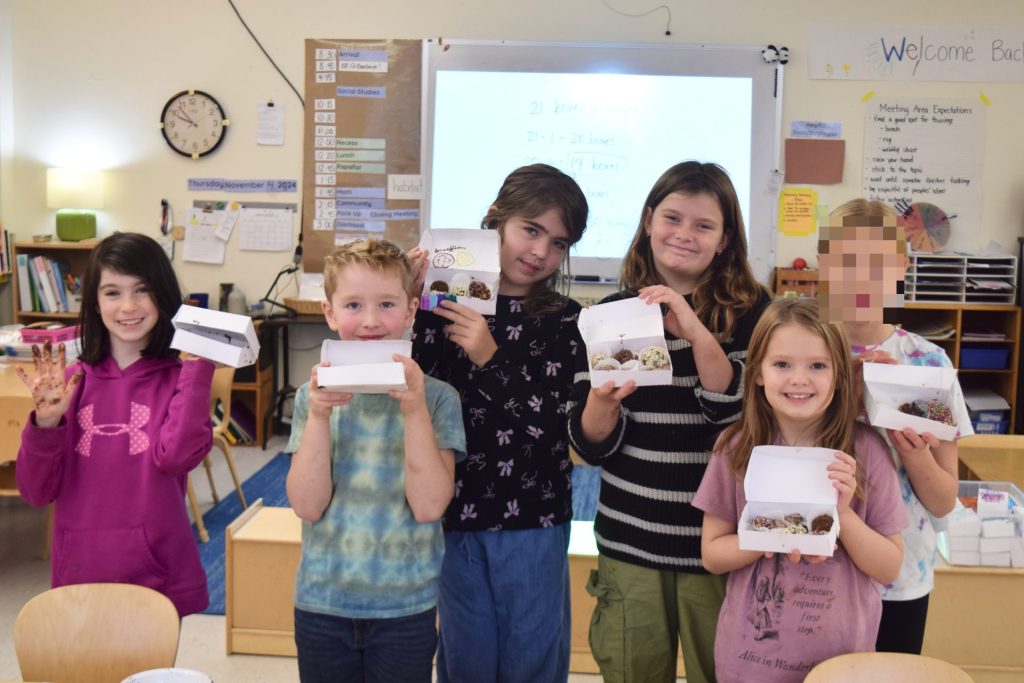
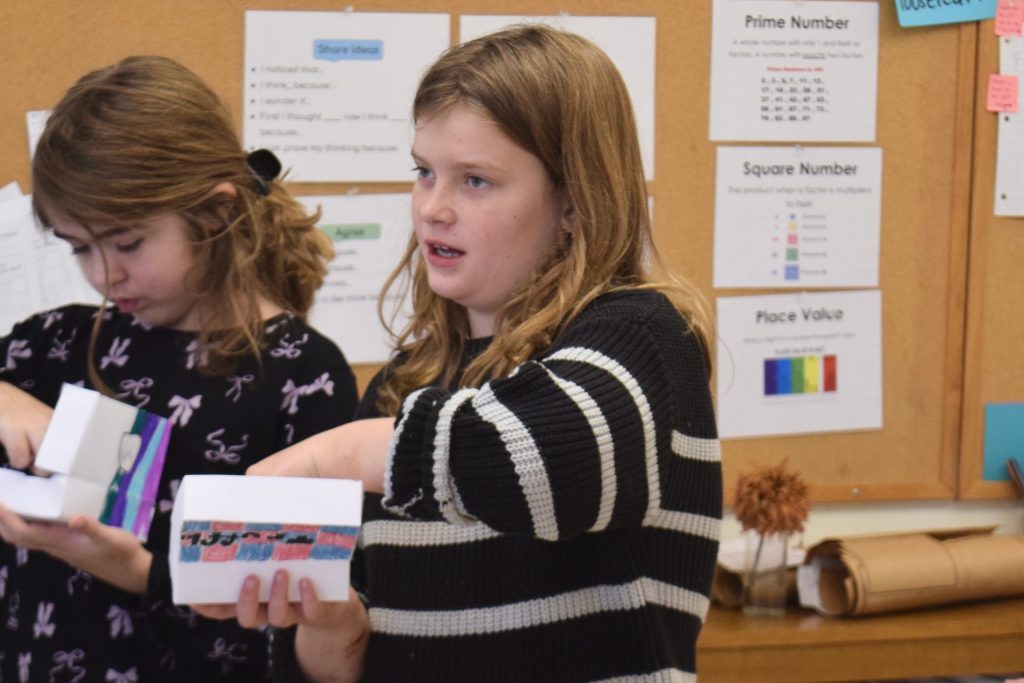
3rd and 4th Grade students show off boxes of truffles they made at the end of the “Muffles’ Truffles” unit.
When students’ only interactions with math are through worksheets, packets, and tests, it’s not difficult to see why they often lose interest. At Poughkeepsie Day School, children are given the opportunity to take in all the same content by way of hands-on, collaborative experiences that expose them to real-world, practical applications of their learning. This past month, for example, 3rd and 4th-graders in Samantha Nadal’s classroom learned about place value patterns; unitization; partial products; and the distributive, commutative, and associative properties of multiplication in an interesting way: by taking on the role of workers at a fictional truffle shop.
The unit, entitled “Muffles’ Truffles,” revolves around the imaginary story of a man named Muffles who runs a truffle shop that packages the treats in boxes of 10 each, with only 1 flavor per box. The truffles are very good, and the business started to grow rapidly, so Muffles had to hire assistants—our 3rd and 4th Grade students—to help him package. Muffles was only interested in creating a variety of truffles each morning and labeling the trays with the total amount for each flavor, leaving all business-related work to his assistants. As the shop became more and more famous, correctly packaging and pricing the treats became much harder, and the 3-4 class was now faced with having to devise strategies to complete these tasks in a timely manner in order to keep business running smoothly.
On day 1 of the project, after hearing this initial background story, students were shown a model of what each box of 10 Muffles’ Truffles looks like—an array with 2 rows and 5 columns. However, it was not referred to as an array, just a box with equal rows and columns of truffles, keeping everything in the context of the story. This approach is used consistently throughout the unit, and allows children to form an understanding of the practical function of mathematical models and concepts before putting formal names to them.
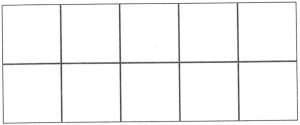
A “blueprint” of a truffle box, as shown to students on day 1.
Then, our newly-hired assistants were presented with their first problem: Muffles has prepared an enormous amount of truffles in an assortment of flavors and left them out on labeled trays for packaging. The amount of truffles made varies from hundreds of some flavors to only a few of others, and none of these quantities are multiples of 10 (i.e. 218 raspberry truffles). So, how many boxes are necessary for each flavor? How many truffles will be left over after boxes are filled with ten truffles each? How much does the shop stand to earn if all truffles are sold for $1.00? These were the students’ only directives; there was no lesson instructing them on how to organize their thinking or what strategies to employ. In pairs, students were indirectly asked to use their own methods and prior knowledge to answer each question. Some used base-10 rods and centimeter cubes to visualize the boxes and leftover truffles. Some applied an established understanding of place value to separate the 100s, 10s, and 1s places for a given truffle total to efficiently determine how many tens are in a number. The children were being introduced to the application of multiplicative strategies and number system concepts in a realistic context.
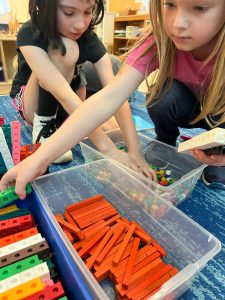
Two 3rd-grade students utilize centimeter cubes and base-10 rods to aid in their investigation.
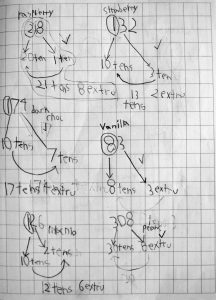
Student work showing how they used place value positions in each truffle count to figure out how many boxes need to be made of each flavor and how many truffles will be left over.
The next day, each partnership was asked to synthesize their process and understanding by making a poster to demonstrate the strategies they used to solve day 1’s dilemma. This encouraged everyone to both reflect on and effectively communicate their own mathematical thinking. During a whole-group gallery walk of each partnership’s poster, students left feedback on each other’s work using sticky notes, sharing ideas and noting connections between their own reasoning and that of their classmates. This was followed by a math congress where individual pairs presented their posters in order to elaborate on their strategies and the organization of their thinking. This process not only provided opportunity for further reflection, but also introduced students to their peers’ other, possibly more efficient ways of solving the previous day’s truffle shop troubles. Additionally, it made for a perfect opportunity for their teacher, Samantha, to highlight those methods and model them both visually and with formal notation. For the particular group of questions the class faced on day 1, understanding place value, skip counting by 10, and unitization—for example, recognizing that 10 is made up of both 10 groups of 1 and 1 group of 10—were the main points of focus.
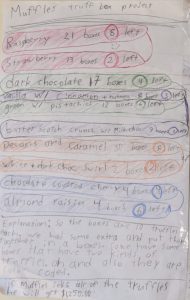
A partnership’s poster where they describe their mathematical strategy of using place value.
Similarly, the children’s introduction to partial products and the distributive property came by way of another predicament at the truffle shop: Patrons were upset that truffles were only made in boxes of 10—they wanted more flexibility in case they happened to be in the mood for more or less sweets. So, using graph paper, students created their own blueprints (arrays) of new rectangular boxes with different dimensions, labeled the total number of truffles it could hold, and its price. This was new territory, but the 3rd and 4th Grade were able to use strategies from the previous day’s math congress and gallery walk to get started. For example, some students applied their new understanding of unitization to count the number of rows or columns in their new blueprints and use repeated addition to tally the total price and amount of truffles. This also gave rise to another important revelation: knowing the dimensions of one box can support you in determining the total number in a box with similar dimensions. For example, knowing the total of a 3×5 can help you solve for a 3×6 array. Following this exploration, another math congress was held where Samantha formally introduced these concepts by demonstrating the use of partial products and open arrays (still just being called truffles boxes) and formal notation.
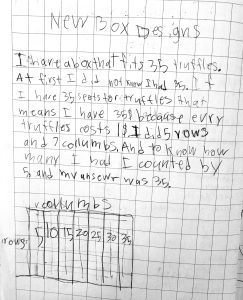
Student work demonstrating their understanding of unitization, using repeated addition of rows and columns to determine the total amount and price of truffles in their new box design.
On day 5, to further solidify the 3rd and 4th grade’s understanding of partial products and the distributive property, another truffle shop situation was presented in which one of the class’s fictional coworkers came up with the idea of combining the classic 1-flavor, 10-truffle boxes to make bigger ones with multiple flavors. To explore this suggestion, children were provided with cut-outs of the original 2×5 box blueprints and asked what sizes of boxes could be made by putting them together, and how many flavors each new box could hold. Since the students already knew a single box could hold 10 truffles, putting these same-sized boxes together to make new, bigger ones brought home the idea that smaller arrays can be used to determine the dimensions of larger ones.
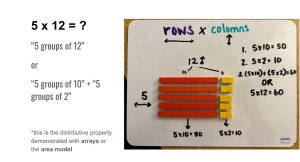
Graphic and model by teacher Samantha Nadal using two different arrays (partial products) to the demonstrate the distributive property of multiplication.
During the activity, students also noticed that some boxes with the same amount of truffles had different dimensions—for example, a 4×5 and 2×10 box hold the same amount of candies. Through a teacher-led discussion, students examined the patterns in these related equations and devised conjectures as to why the product would be the same. First through doing, then through group analysis and discussion, the class was now starting to discover the commutative and associative properties of multiplication.
The next day, the distributive, commutative, and associative properties were explored more deeply in another gallery walk and math congress. During the congress, teacher Samantha was once again able to use open arrays and formal notation to model the patterns students found with their truffles and boxes.
The final day in the Muffles’ Truffles unit involved a twist in the story—another mishap caused by a fictional shop coworker, and Muffles himself! Muffles decided that, for his newly combined boxes from day 5, he should order special gold foil to wrap them in. Well, another assistant of Muffles made a bunch of his own different-sized boxes and wrapped them in the foil without labelling them with a price first. Now, nobody knows how many truffles are in each, and therefore how much they should cost. So, Grades 3 and 4 were tasked with figuring out the total number of desserts the boxes could hold (their dimensions) using only outlines of each one (open arrays). Samantha used paper and scissors to cut out these outlines with specific dimensions, true-to-size in inches, as well as one copy of a 5″×5″, 2″×5″, and 1″×5″ box blueprint (closed arrays) that students could use as measuring tools. The idea, again, was for the class to use smaller arrays to determine the dimensions of bigger ones. However, now equipped with their experience of all previous truffle shop predicaments, gallery walks, and math congresses, Grades 3 and 4 were able to express their thinking in sophisticated ways, creating their own open arrays and using standard notation. Once the dimensions of one box outline was solved, students again combined their understanding of unitization and the distributive property to determine the dimensions of others using partial products. Several box outlines had lengths or widths in common to encourage this strategy. Overall, it was a great way to end the unit.
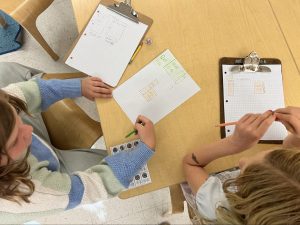
Students in the process of using multiple arrays to determine the dimensions of the foil-wrapped boxes.
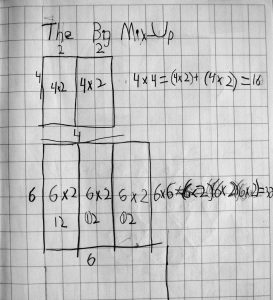
On the last day of the project, after experiencing all previous math congresses, gallery walks, and truffle shop scenarios, this student was now able to use open arrays and formal notation to model their thinking.
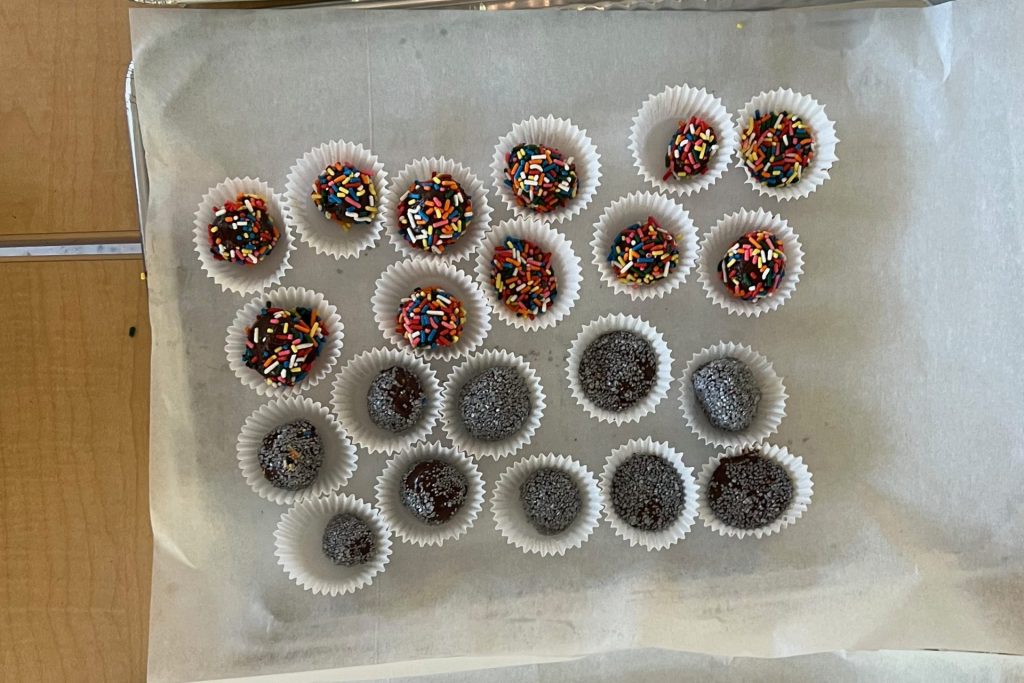
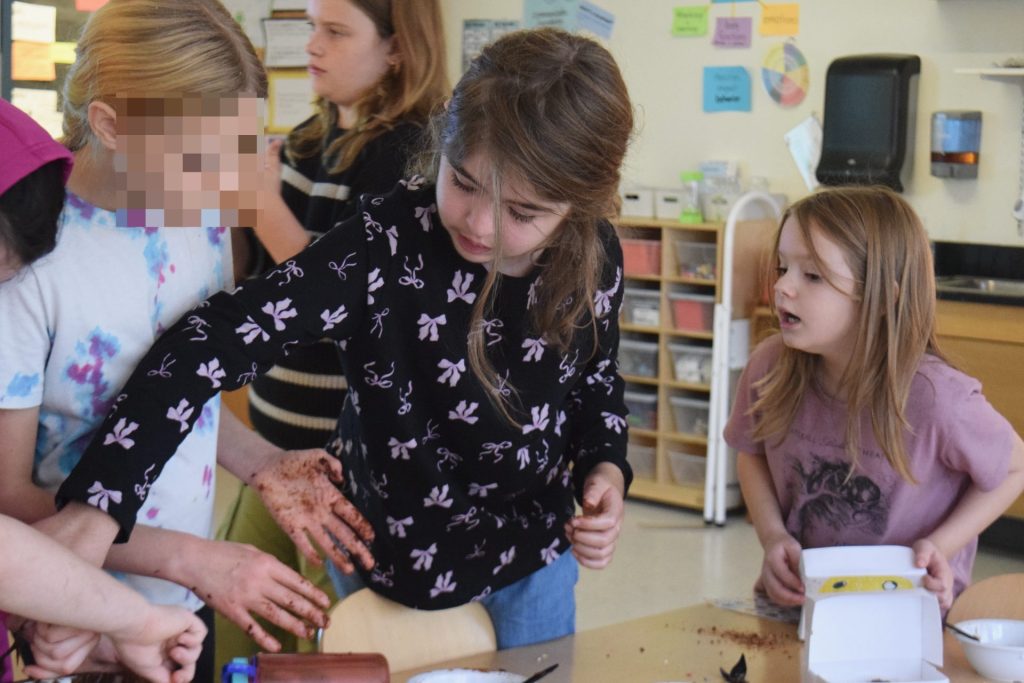
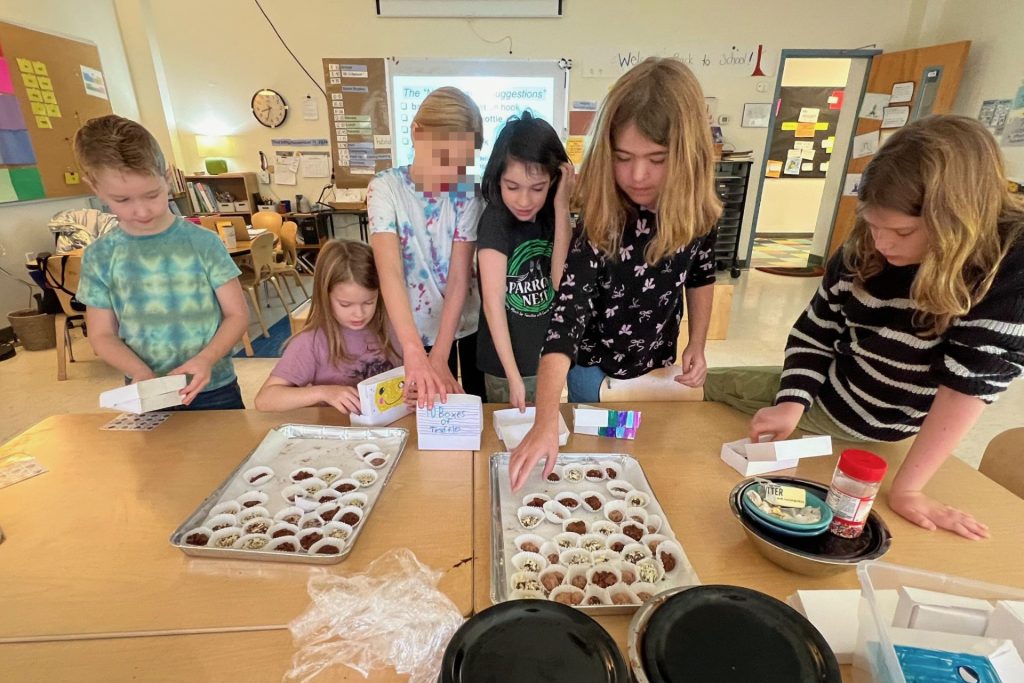
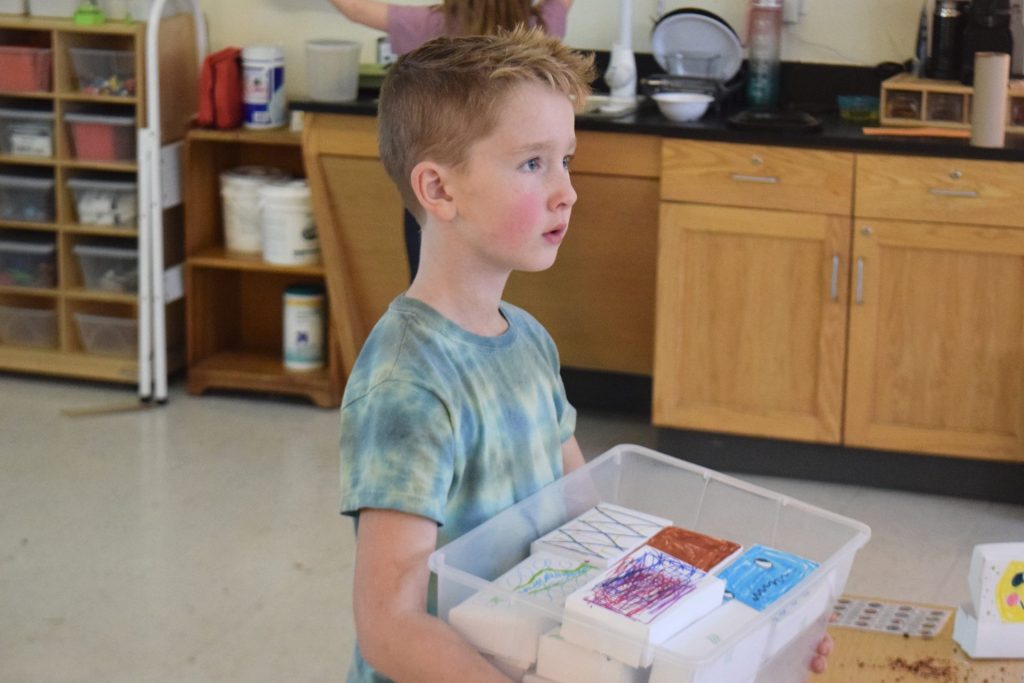
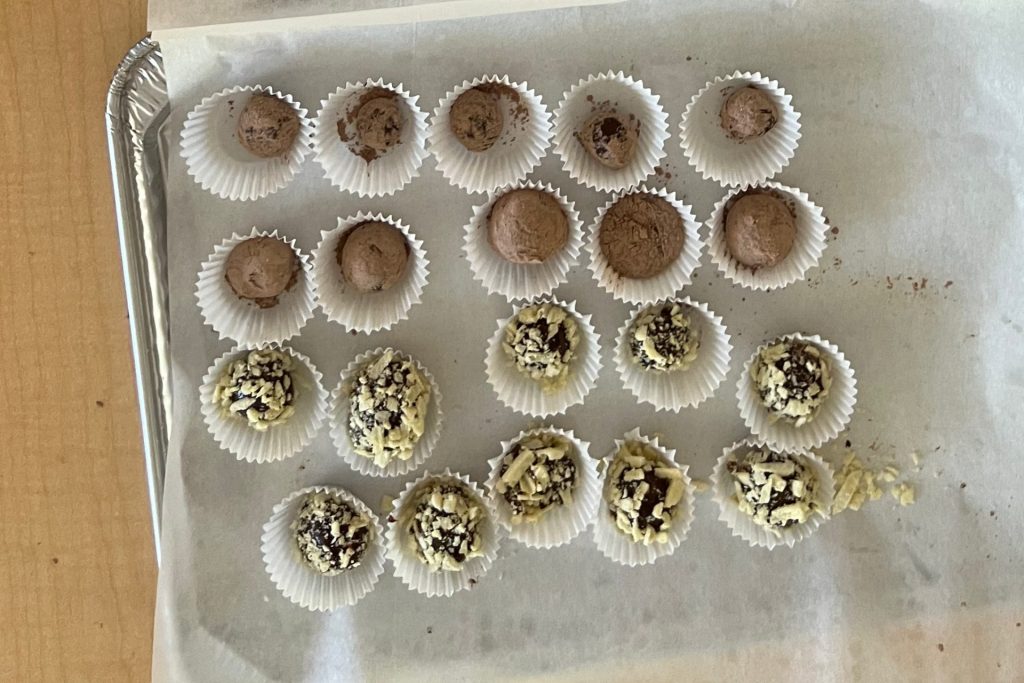
Once the formal Muffles’ Truffles unit was over, Samantha’s class took their study—and role as packaging assistants—a step further by going around school and taking real orders of truffles from every other classroom in the school. These orders were recorded on forms that forced the 3rd and 4th grade to use multiplication and division to figure out the total number of truffles and boxes they needed to make. After exercising their newly developed skills to determine how many treats to make, the class used milk, chocolate, butter, cocoa powder, vanilla extract, and other ingredients to prepare truffles to order! They designed and decorated their own boxes that held 10 truffles each, and packaged them to be delivered. During delivery to each class, students provided receipts their multiplicative thinking was correct, and that they made the right amount of truffles. And, to top it all off, the truffles were a hit!
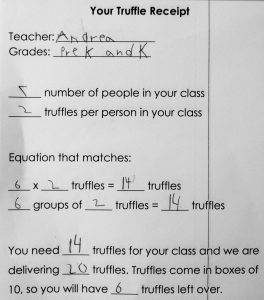
A receipt for Andrea’s PreK and Kindergarten class proving the 3rd and 4th Grade’s math to determine the amount of truffles made for the order.
-
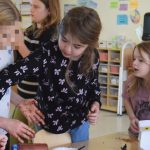
- Truffle making and delivery in action!
-
- Truffle making and delivery in action!
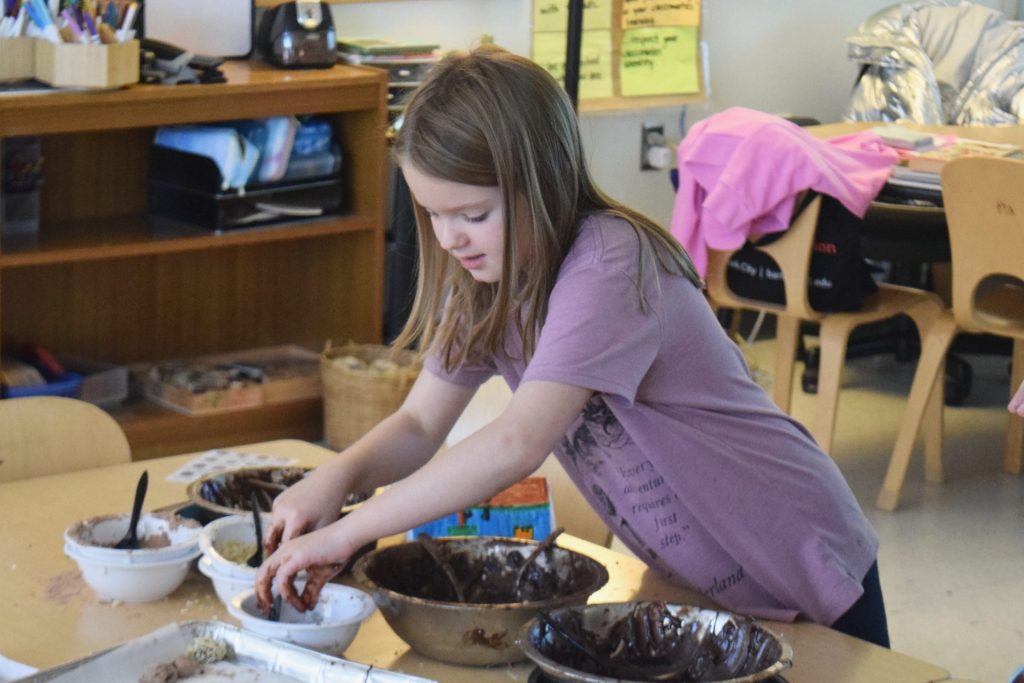
-
- Truffle making and delivery in action!
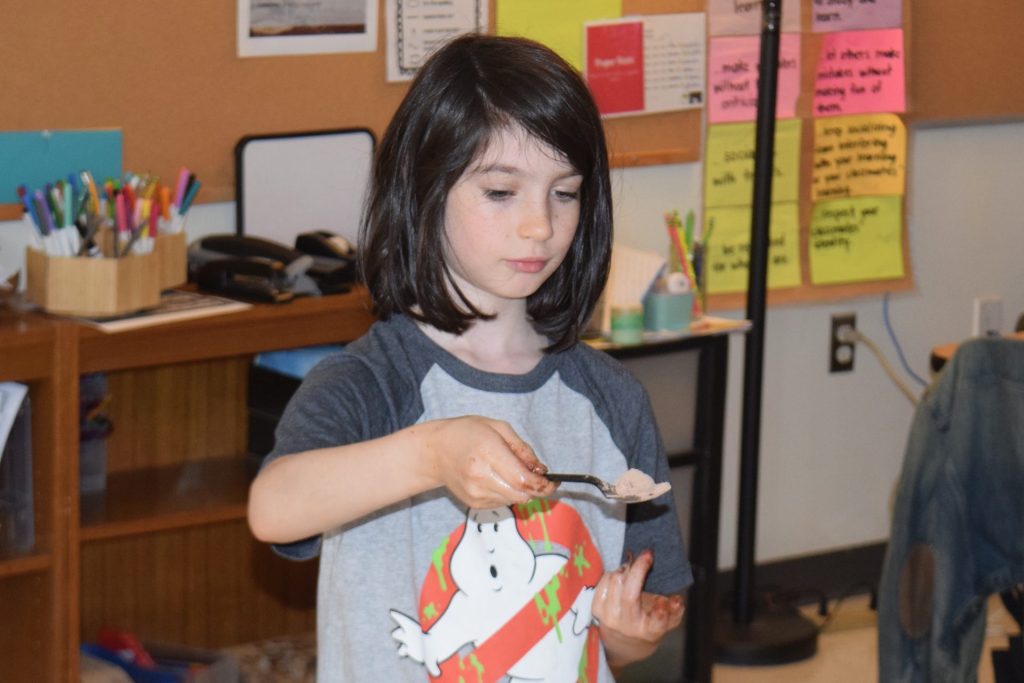
-
- Truffle making and delivery in action!
-
- Truffle making and delivery in action!
-
- Truffle making and delivery in action!
-
- Truffle making and delivery in action!
-
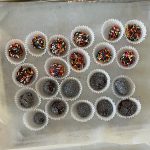
- Truffle making and delivery in action!